Our journey
continues…
Sunday morning
we left Cloquet, heading to Detroit Lakes, MN and the Forest Hills RV and Golf
Resort, where we would spend 4 nights. I covered the park details in last week’s
blog. Although there wasn’t much action there we managed to find things to do.
Monday, the day
after we arrived at Forest Hills RV and Golf Resort, we took advantage of the
internet in their family activity center to catch up on emails and all things
internet. This park has no cable or internet at the individual sites, so we had
to pack up our gear to go either to the family center or to the local library
in town.
Winegard
stock antenna:
|
Channels:
|
North-South
|
0
|
East-West
|
1
|
Southeast
-Northwest
|
1
|
Southwest-Northeast
|
0
|
The
KING Jack
|
Channels:
|
North
|
18
|
Southeast*
|
9
|
Southwest*
|
9
|
West
|
22
|
East
|
19
|
*my
rotation did not allow a due south setting.
|
|
Tuesday morning
Dick installed a new “KING Jack TV” antenna on our camper, in order to improve
our local TV reception. It’s a replacement for our original equipment, Winegard
‘batwing’ antenna, which had given us good reception if the local TV transmission towers were close by. Otherwise—not so
good. The closest TV transmission to Forest Hills Golf & RV Resort in
Detroit Lakes was in the Fargo, ND/Moorhead, MN area, some 40+ miles west of
us. We tested the reception before and after installing the new KING Jack
antenna. WOW! What a difference! Here are the results of our test:
You can check
out more information on the official KING products web page at kingconnect.com.
The weather was
a bit chilly for outdoor activities, so we hit the library on Tuesday afternoon.
In addition to screaming internet, Dick found a few books on their book sale
table. He was happy!

The Detroit
Lakes Public Library was built in 1913 with a $10,000 grant from the Andrew
Carnegie Foundation. Now on the National Register of Historic Places, the
library, designed in the prairie school architectural style, features lead and
stained glass windows and doors, with a completely unobstructed interior. It
also is noted for its orange and clay-tiled hip roof. Originally just 4,142
square feet on two floors, the library offered just 1,000 books to its readers.
In 1985 the library building was expanded to what it is today.
By the time we
were done at the library we decided dinner in town was on the agenda, so we
headed to Zorba’s, considered the best Mexican and pizza joint in the area. We
were rather skeptical: Greek name, Mexican fare and pizza…hmmm… It’s kinda
crazy, but in all their advertisements, menus--actually anything in print—has
all “s’s” changed to “z’s”. Was rather hard to read, and their menu is
extensive, but here’s an example, taken from their website, zorbaz.com:
 “Zorbaz on the Lake waz conceived in 1969 and eztablizhed juzt barely in
an old candy ztore by a dizgruntled zpeech teacher and hiz dental azziztant
wife. The name comez from the popular 1960'z movie Zorba the Greek ztarring
Anthony Quinn. Zorba waz fun loving, free zpirited, carefree and happy.
“Zorbaz on the Lake waz conceived in 1969 and eztablizhed juzt barely in
an old candy ztore by a dizgruntled zpeech teacher and hiz dental azziztant
wife. The name comez from the popular 1960'z movie Zorba the Greek ztarring
Anthony Quinn. Zorba waz fun loving, free zpirited, carefree and happy.
Exactly the atmozphere and attitude the teacher and hiz bride wanted for
their no zhirt, no zhoez, no problemz northern Minnezota lakez area beach bar.
Why Mexican food and pizza inztead of gyroz, lamb and baklava? Why not!
Many call uz a reztaurant but that'z not exactly how we zee ourzelvez. We
are a great timez Mexican and Pizza Joint. We have the bezt ztaff in the
midwezt and we are zelf-zervice with a zmile. We have the lakez area'z bezt
beer zelection, our pizza dough iz homemade and our zalza iz frezh daily. There
are gamez for kidz of all agez and you can come by car, boat, znowmobile, or
float plane. Tie up at our dockz. Preferred by Jamez Buffet.”
We each had a “pregnant burrito” (one each of beef
and chicken) and margaritas. YUM! They were quite possibly the best burritos
we’ve ever had. We’d definitely recommend Zorba’s if you’re in the Detroit
Lakes, or one of their other 10 locations throughout Minnesota. Check out their
website for locations at zorbas.com.
A visit to the Becker County Museum was on our list
of things to do, on Wednesday. As we’ve done in the past, we wanted to learn as
much as we could about the area.
“Development of the Detroit Lakes area began in 1871, as the
Northern Pacific Railroad grew westward through Becker County. Settlers from
the East reached this new territory to discover a small, country community
called Tylerville or Tyler Town. Tylerville consisted of a collection of buildings
near the cabin of Mr. Merwin Tyler, a 12 by 14-foot cabin that also served as
the local hotel and post office. Mail, brought by the Northern Pacific
Railroad, was emptied onto a bed for the locals to help themselves.
Detroit Lakes was founded by Colonel George Johnston, who came
to Minnesota in 1871 to select lands for the New England Colony. Consequently,
Detroit Township was established. The name Detroit came about when a French
Catholic Priest camped on the shores of the nearby lake with a view of the sun
setting across the water. The water was low and revealed a sandbar, creating a
narrow strait that glistened in the light of the setting sun. The Priest
exclaimed, “What a beautiful strait.” (The French word for strait is “detroit.”)
Thus, the city was named Detroit. However, as a result of continuous postal
mix-ups between Detroit, Minnesota and the better-known Detroit, Michigan, a
special election was held on September 7, 1926 to change the city's name to
Detroit Lakes. This name stuck and has remained ever since.
Beaver and other fur bearing animals were heavily trapped
throughout Northwestern Minnesota in the early 1800's. And, in 1873, Detroit
Township boasted the first grain warehouse built west of Duluth on the Northern
Pacific Railroad line. To add to the excitement of an ever expanding town, packs
of wolves howled in the streets at night, and bears were a common sight. The
telephone system was introduced to Detroit in May 1884 with just 6 telephones
in operation. Until 1885 when the county purchased firefighting equipment, firefighting
was handled by early settlers who worked together in bucket brigades. The new
equipment came in handy when the Holmes Opera House burned in 1888, and the
1914 fire that destroyed 22 buildings, including the beautiful Hotel Minnesota,
an elegant four-story hotel.
Here are a few photos taken at the Becker County Museum, most
depicting life back in the day.
 |
| Tributes to those who served in the military, the announcement of Lincoln's death and funeral, a bicycle made in England but transported to Detroit Lakes in the 1880s, a parrot who upon the death of his owner wouldn't eat so starved himself to death, a human hair wall decoration, and a rosemaling chest are just a few of the items we thought were of interest. |
 |
| Other items of interest were the moonshine still (favored by one Judge Kukoske most Sunday mornings), the arrowhead collection (this is just one of 4 displays), the 1800s gun collection , a display of toys from the 1800s, a vintage hair curler, baskets made by Native Americans, and their regalia. |
Thursday morning we did the final packing up to begin our long
trek to Medora, ND, a mere 378 miles away. We pulled out of Detroit Lakes at 9:00
a.m. Thankfully the roads were excellent, and it was a pretty straight shot to
our destination, “The Red Trail Campground” in Medora. Since our drive took us into
Mountain Daylight Time we had an extra hour added to our day, so we arrived at
2:30.
Some of the following information was taken from Wikipedia, with
my thoughts and other stuff thrown in for variety. Here are some photos from
Medora to give you an idea of what a cool little town Medora is (population
112).
 |
| These photos are of some of the historic buildings in Medora:Joe Ferris General Store, the Mercantile, the Post Office and Bank, the Rough Riders Hotel (so named after Teddy Roosevelt), St. Mary's Catholic Church commissioned by the Marquise de Mores, and a memorial to those who have served in the military, |
 |
| More of Medora: the Children's Park built by Harold Schafer, the Medora trusty weather report, Dakotah Stores, an old wagon , the remains of the Marquis' meat packing plant, and the Medora Fudge and Ice Cream Depot. |
Medora was founded in 1883, along the transcontinental Northern
Pacific Railway, by French nobleman Marquis de Mores (pronounced Moor), who
named the town after his wife Medora von Hoffman. His vision for this town was to
develop a cattle empire and meat packing plant, shipping refrigerated meat to
Chicago via the railroad to provide urban consumers with a better quality meat.
The Marquis invested heavily in his dream, building the packing plant, buying
cattle and land, and employing cowboys and workers. For 3 years Medora hummed
with activity. He also built houses, businesses (including ranches and a stage
line), and a Catholic church.
Although the plant he built could process 150 beef carcasses per
day, finding cattle that were fit to butcher was difficult, due to the ongoing
drought in the badlands. The Marquis left Medora after the plant closed in
1886. The family seldom visited Medora following the collapse, a failure due to
fierce competition from major Chicago-based meat packers, the effects of bad
weather and drought, market failure, and his inattentiveness to his business
interests. His dream, however, created a romantic legacy that lives on in
Medora.
The Marquis’ most striking legacy is the rustic but aristocratic
26-room home, called “the chateau” by locals, overlooking his town and
enterprises. Rich furnishings and oriental carpets, as well as fine
accoutrements accommodated the family and their wealthy guests, including
Theodore Roosevelt. The family occupied the home for 3 years, returning to New
York during the harsh winters. The chateau was maintained by caretakers until
1936 when family members gave the Medora properties to the State of North
Dakota.
--
Roosevelt first visited the badlands in 1883, and before
returning home he became interested in the cattle business, joining 2 other men
as partners in the Maltese Cross Ranch. Returning the next year he established
a 2nd open-range ranch, the Elkhorn, as his own operation and
principal residence, north of Medora. The prospect of big game hunting had
drawn him to this area, but he soon realized that the large herds of bison were
gone, having been decimated by hide hunters and disease. Alarmed by the damage
being done to the land and its wildlife, witnessing the destruction of some big
game species, and the overgrazing of the vast grasslands, Roosevelt quickly
recognized the need for conservation. When he became president in 1901,
Roosevelt pursued this interest in natural history by establishing the U.S.
Forest Service and by signing the 1906 Antiquities Act under which he
proclaimed 18 national monuments. He also got approval for the establishment of
5 national parks and 51 wildlife refuges, and set aside land as national
forests.
“I never would have been
President if it had not been for my experiences in North Dakota,” said Roosevelt when reflecting on
the influences that affected him throughout his life.
February 14, 1884 brought tragedy to President Roosevelt’s life,
when news reached him that his wife and mother died within hours of one
another. Alice Lee, his wife of four years had died of Bright’s disease, a
severe kidney ailment, just 2 days after having given birth to their daughter
Alice; his mother died of typhoid fever. Following this devastation, Roosevelt
ordered those around him not to mention his wife’s name. He abandoned politics,
leaving the infant Alice with his sister Bamie, and at the end of 1884 left for
the Dakota territories, where he lived as a rancher and worked as a sheriff for
2 years. Raising cattle and acting as a local lawman took most of his time, but
he did find time to indulge his passion for reading and writing history. After
a blizzard wiped out his prized herd of cattle in 1885, Roosevelt returned to
eastern society and politics.
In the evening of April 7, 1903, President Theodore Roosevelt
visited Medora on a presidential tour of the American West, with most of the
folks residing in the Badlands turning out to welcome him on his whistle stop.
Roosevelt said later that “the entire
population of the Badlands down to the smallest baby had gathered to meet me…
They all felt I was their man, their old friend; and even if they had been
hostile to me in the old days when we were divided by the sinister bickering
and jealousies and hatreds of all frontier communities, they now firmly
believed they had always been my staunch friends and admirers. I shook hands
with them all and…I only regretted that I could not spend three hours with
them.”
A
local hotel changed its name that same year to the Rough Riders Hotel. The
hotel is now owned and operated by the Theodore Roosevelt Medora Foundation.
As
a side note, Custer spent some time in Medora on his way to Montana.
--
 |
| Red Trail sign, office, our site, and one of the resident park bunnies. |
Red Trail Campground is located just off exit 27 on I-94 in
Medora. The campground, family-owned and operated for 4 generations, is nestled
just below a butte on the southeast edge of this historic town
Although the campground is older, the 100 sites all have free
WiFi access. Full hook-ups are available in most sites; cable is extra. One of
the nice features of the park is escorted parking to the site; and, they stay
around until you’re situated. Cool, huh.
Thursday, the day we arrived, the weather was in the cool 60s;
we were hoping the sun would begin shining for us, and we didn’t have much of
that in Detroit Lakes!
By Friday the sun had come out and the temperatures began to
climb. Yea! For a town the size of Medora, population about 112 (2010 census),
there’s a lot to do! We started our touristy activities that day, by visiting
the Theodore Roosevelt National Park.
As an aside one of the best bargains in the USA is the Senior
Pass. As part of the American the
Beautiful - National Parks and Federal Recreational Lands Pass program, U.S.
citizens or permanent residents who are at least 62 years old can purchase a
Senior Pass for a one-time processing fee of $10. The Senior Pass provides the following
benefits:
·
In
National Parks that charge an entrance or standard amenity fee, the Senior Pass
admits you and the passengers in your car or other private vehicle.
·
In
National Parks where a "per person" entrance fee is charged, the
Senior Pass admits you plus three other adults (who need not be seniors). This
is an especially good deal if you are also traveling with grandchildren,
because children under 16 have free admission.
·
The
lifetime national parks Senior Pass also gives seniors a 50 percent discount on federal use fees
charged for camping, swimming, boat launching, parking and tours.
·
In
some cases where use fees are charged, only the person named on the Senior Pass
will be given the 50 percent discount.
·
The
senior pass is non-transferable and does not cover or reduce special recreation
permit fees or concession fees charged by private companies
The Senior Pass to national parks cannot be purchased by mail or
online. It must be purchased in person
at a federal area where entrance fees are charged, or at regional offices of
the National Park Service, the U.S. Forest Service or the U.S. Fish and Wildlife Service.
Proof of age, such as a valid driver's license, is required at the time you purchase
your senior pass.
For more information about the National Parks Lifetime Senior
Pass, call the National Park Service at 1-888-ASK-USGS.
With the Senior Pass we were admitted to the Theodore Roosevelt
National park at no cost (the regular rate for entry to the southern unit was
$30/vehicle). We have used our Senior
Pass all over the U.S. in National Parks, Corp of Engineers camping and Civil
War battlegrounds – WHAT A BARGAIN!
Access to the southern unit of the Theodore Roosevelt National Park
is right in the town of Medora. The visitor center located at the park’s
entrance provided us with information to make our visit there very enjoyable.
Within the center is a 17-minute movie about the park and Roosevelt’s time in
the area. Behind the center is his restored “Maltese Cross” cabin, a small
3-room cabin, with real glass windows, and an attic, both of which were rare
for this area at the time he built it. The museum at the center displays
Roosevelt’s personal items, and includes ranching artifacts and natural history
displays. While visiting the center, the nationally known actor Joe Weingard
who portrayed Teddy Roosevelt in the History Channel’s The Men Who Built America, was there to further add interest and
to answer any questions we had. (He was very
believable!) Weingard has appeared at the Whitehouse for a portrayal of
Roosevelt for President George W. Bush.
 |
| Theodore Roosevelt National Park entrance sign and visitor center; the Maltese Cross "cabin" (just one of the 2 "homes" he built), the living room, kitchen and bedroom in the cabin. The desk, corner cupboard, trunk did belong to Teddy. |
 |
| Joe Weingard as Teddy Roosevelt met us in the visitor center; Teddy's pension for birds is interesting as he started the art of taxidermy when he was just 11 years old; bison in the park, and a few vista shots. |
We elected to drive the 36-mile scenic loop through the park, to
get a glimpse into what Roosevelt saw that made him fall in love with this
area. We were fortunate to see bison, hundreds of prairie dogs, and wild
horses.
While on our tour, at one of the overlooks, we met Dick and
Louise from Florida, with whom we chatted for quite a while. They spend 2-3
months on the road in the spring and up to a month or 2 in the fall. Dick isn’t
quite ready to give up his house, although Louise would take off in a minute!
 After our scenic drive we had lunch at “Boots Bar and Grill,”
located directly across the street from the park’s entrance. I dined on a
grilled chicken sandwich and house salad, while Dick had chicken quesadillas.
Sure tasted good, as we were starved! For dessert we walked down to the Burning
Hills Emporium for a few scoops of ice cream. Nothing’s better on a hot
day—sunny and 85°, with 11% humidity. Sure felt warmer than that!
After our scenic drive we had lunch at “Boots Bar and Grill,”
located directly across the street from the park’s entrance. I dined on a
grilled chicken sandwich and house salad, while Dick had chicken quesadillas.
Sure tasted good, as we were starved! For dessert we walked down to the Burning
Hills Emporium for a few scoops of ice cream. Nothing’s better on a hot
day—sunny and 85°, with 11% humidity. Sure felt warmer than that! Saturday our mission was to take in the Theodore Roosevelt
National Park’s north unit, located about 70 miles away up highway 85. This
park offers a 14-mile driving tour through vistas as seen by Roosevelt during
his time here. The northern park is situated along the Little Missouri River.
Saturday our mission was to take in the Theodore Roosevelt
National Park’s north unit, located about 70 miles away up highway 85. This
park offers a 14-mile driving tour through vistas as seen by Roosevelt during
his time here. The northern park is situated along the Little Missouri River.
Although there is a herd of long-horn cattle here in the park,
as well as big horned sheep, we didn’t see any. However—we did see hundreds of
bison along the drive.
While the southern park is beautiful and the vistas
extraordinary, the northern park offers more diverse and unusual geological
formations that aren’t as readily seen in the southern park. We saw beautifully
colored striations, slump blocks, and cannonball concretions.
 |
| Striations |
Slump blocks are formed when huge sections of bluff gradually
slide intact to the valley floor. Canyon walls are too steep to support a
top-heavy formation and through continued erosion the face of the parent bluff
is moved further back from its original position. Blocks generally tilt as they
slump so the bands of color on the bluff and the block can be matched as to
their origination.
The other intriguing formations are the cannonball concretions.
(We saw evidence of these in Arkansas, too.) These unusual formations are hard,
compact masses of matter formed by the precipitation of a considerable amount
of cementing material around a nucleus, such as a leaf, tooth, piece of shell,
or fossil. They can vary in shape, hardness and size, and can be found ranging
in size from minute to huge, such as the giant, red concretions we saw in the
park, which are almost 10 feet in diameter! It was interesting to see them, as
they look as though they don’t belong where they appear, protruding from a
cliff side, or “thrown” randomly in piles. So cool!
 |
| Slump blocks and cannonball concretions |
Returning to
our camper for lunch, we rested for a
bit, deciding on what to do for the remainder of the day. (Medora is packed
full of stuff to see and do!) We decided to walk into town, just a few short
blocks away, to purchase tickets for the Medora Musical preceded by the
Pitchfork Steak Fondue dinner. We’d been told by friends Jamie and Ann (whom we
met at Bay View) that this is not to be missed. We’ll be attending both Sunday
night.
Our next stop
was the North Dakota Cowboy Hall of Fame, a museum dedicated to the
preservation and promotion of North Dakota’s Native American, ranching and
rodeo communities, and rich (and colorful!) western heritage. This 15,000
square foot interpretive center features travelling, as well as permanent,
culture exhibits, a Hall of Honorees, archives, as well as a theater and gift
shop.
 |
| Dakota Cowboy Hall of Fame |
The idea for
this museum was conceived in 1994 and came to fruition, complete with a new
building, in 2005. As seasoned western icon Evelyn Neuens, her sister Goldie
Nutter, and 40 Years of North Dakota
Rodeo author Phil Baird drove home from the 40th anniversary of
the Y’s Men’s Rodeo in Minot (ND), they realized that the state’s rich rodeo
history was scattered to the wind, and that facts and faces were fading with
each aging generation. Baird proposed that they initiate an organization to
honor North Dakota rodeo competitors. Neuens said, with a determined smile on
her 83-year old face, “Let’s do it! I’d rather wear out than rust out.” In May
2005, the barbed wire ribbon was cut and the dream became a reality. Today, annual
memberships and endowments keep this fascinating piece of culture alive and
well.
 |
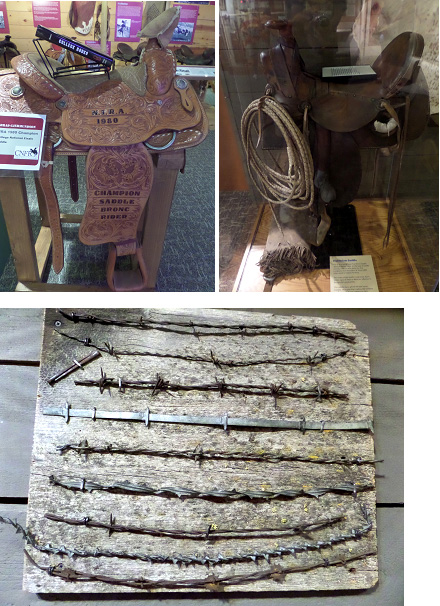
| We thought the horn chair was interesting! The Indian Horse mask is decorated with painted porcupine quills; the Indian saddle is made of rawhide, wood and buffalo bones. Silver Buckles, Native American pouches and vest; tributes to barrel racers and bronc riders |

 |
| The museum had this huge longhorn in the lobby area to welcome you; angora chaps, a very extensive display (12 panels!) of barbed wire; a display of what a general store would look like, wall displays of tools, a side saddle, a rim stretcher for repairing wooden wheels, and a Ukranian chalice cover from the 1750s carried by Leon Trotsky when he fled Russia for Mexico (the cover was a gift to Dr. Stuche of Garrison, ND who had befriended Trotsky). |
A stroll through town revealed more history, as we ended up at the Billings County Courthouse Museum. In 1900s the museum building was originally made up of 2 apartments joined together by a central common storage area between the two. In 1913 a 2nd floor was added to the central part; the 2nd floor housed the courtroom, the judge’s chambers and the clerk of court office. The courthouse symbolized the orderly administration of justice in a county that is one of the least populated in North Dakota. After the original unit was enlarged, the south wing was used as a jail. (A new courthouse and jail was built, adjacent to the old courthouse, in 1983, converting the original courthouse into the present museum in 1986.) The displays depict the history of this area, dating back into the early 1800s. The thing that blew my mind was the huge display of barbed wire. Who knew there were so many types! My, oh, my…
Sunday morning
was a morning of rest and relaxation, before heading out to see more of the
town before our steak dinner and musical at the Burning Hills Amphitheater,
located in Medora.
 Our first stop
was to the historic Von Hoffman house, commissioned by parents of the Marquise
Medora de Mores, The Baron and Mrs. Von Hoffman for their occasional use.
Constructed in 1884, this home is listed on the National Register of Historic
Places.
Our first stop
was to the historic Von Hoffman house, commissioned by parents of the Marquise
Medora de Mores, The Baron and Mrs. Von Hoffman for their occasional use.
Constructed in 1884, this home is listed on the National Register of Historic
Places.
Several years
after the Von Hoffman’s last trip to the area in 1885, James Foley, Sr., and
his wife Gertrude lived with their children in the home. In 1914, the de More’s
transferred ownership of the house to the Foley family (James Foley, Sr. was
the manager of the de Mores’ property in Medora for 35 years; he was named the
unofficial Poet Laureate of North Dakota, and wrote the North Dakota State
Hymn).
This recently
restored home includes a collection of original furniture and period
furnishings. The upstairs gallery displays the Ferris family’s correspondence
with their friend Theodore Roosevelt.
 |
| It's difficult to see, but there were about a dozen bumble bees collecting pollen from the lavender bush; then we noticed these butterflies. |
 |
| The Chateau visitor center; the Marquis and Marguise de Mores; their children Louis and Athenais (photo dated 1881) and the youngest son Paul (photo dated 1905) |
On to the
“hunting cabin” of the Marquis and Marquise de Mores, the Chateau de Mores. The
chateau itself is a 2-story, 26-room wood frame building, and although not a
true chateau it was given the name by the locals, as it was considerably more
luxurious than most contemporary homes in the area, which were mostly
constructed of sod or logs. Built in 1883 as the summer residence of the
Marquis’ family, it was occupied only seasonally by the family, and only for 3
years, from 1883 to 1886. During the harsh winters of North Dakota, they would
return to New York and France, returning in the spring. After the decline of
the Marquis’ business interests in Medora, he returned to the chateau only
twice, in 1887 and in 1889. Medora and their children visited only once more,
after the Marquis’ death in 1903. From then on the home was maintained by
caretakers, who would ready the house for occupation, but the family never
returned. The eldest son, Louis, gave the caretakers permission to operate the
chateau as a boarding house in 1921, but during this period the house suffered
from theft and lack of maintenance. The home and land on which it sat was given
to the State of North Dakota in 1936 on the condition that it be maintained and
open to the public. The Civilian Conservation Corps restored the home from 1937
to 1941, and again in 1995. The chateau is now a historic house museum and
contains many of the original furnishings and personal effects of the de Mores’
family. You'll notice that the interior photos are very dark, due to no electricity in the home i keeping with life at the time.
 |
| The Chateau de Mores (front and rear), dining room, kitchen, dish washing room, and a display of wine found in the cellar (over 600 bottles, including bottled water) |
 |
| The Marquis' bedroom, smoking room, and his bathroom. The Marquise's room is next, her parlor and the nursery and nanny's room. |
 |
| Traditonal bathtub (your feet hung out!), one of the many bedrooms, a maid's room, and and example of a straw mattress |
 |
| The "hunting room" where preparations were made for the many hunts that the de Mores participated in. (The Marquise was a better hunter and shot than her husband!) A hunting chest in which fresh meat was packed in salt for transporting back to the Chateau. The upstairs hallway, which also served as a church until the Catholic Church in town was completed. "Paper" stained glass made from colored tissue paper and sealed with a substance making it appear like real stained glass. |
 |
| The Tjaden Fondue Terrace, meat being prepared for fonduing, our meal and a rainbow that blessed us as we were eating. |
At
5:30 we drove further up into the badlands hills for our Pitchfork Steak Fondue
dinner at the Tjaden Terrace adjacent to the amphitheater. Their chefs loaded
12-oz. rib-eye steaks onto pitchforks, then fondue them in large vats. For
$29.00 per person we enjoyed our meal of steak, baked potatoes, coleslaw, baked
beans, fresh veggies and dip, brownies, cinnamon donuts, lemonade and coffee.
What’s not to like? (As a side note, the Pitchfork Steak Fondue dinner was
featured on the Food Network’s show Best
Of.)
Sitting
at long tables, we shared our meal with about 200 other folks, and met Stu and
Janice from Pennsylvania, and Dan and Sheryl from Arizona.
A
short walk across the parking lot brought us to the Burning Hills Amphitheater.
Built in 1958, the first production was “Ol’ Four Eyes,” a tribute to Theodore
Roosevelt to help celebrate his 100th birthday. The amphitheater was
carved out of the side of the badlands in Burning Gulch by volunteers, cast
members and boys from the Home on the Range Ranch. Seeing between 1,000 and
1,200 people, it was constructed of wooden benches with rustic buildings that
formed a set around the stage. Natural acoustics meant no sound system would be
needed.
“Ol’
Four Eyes” ran until 1963 when it was replaced by “Teddy Roosevelt Rides Again”
for the 1963 and 1964 seasons. Former North Dakota businessman Harold Schafer
bought the amphitheater in 1965, and started the Medora Musical. In 1991 the
amphitheater received a $4.1 million facelift, which added additional seating
(now seating up to 2,900), a new stage, escalators, and wheelchair ramp. The
new Burning Hills Amphitheater was completed in 1992, and the new construction
was completed in 1997. Another renovation took place in 2005 which upgraded the
sets and stage, allowing them to move left and right, forward and back.
 |
| The Medora Musical stage and sets, with the Burning Hills Singers and Coal Diggers band. |
The
Medora Musical celebrates its 50th year with a “rootin’-tooinest,
boot-scootinest show in all the west!” This high energy, western-style musical
is dedicated to the legacy of Roosevelt, America’s 26th President,
and the time he spent in the badlands of Dakota Territory. Songs performed by
the Burning Hills Singers (12 young men and women from all over the U.S.), the
Coal Diggers (live western on-stage band), the Queen of the West and Wild West
Prestidigitator, live horses on stage, and featured entertainer comedian Carl
Guerra, kept us entertained for over 2 hours. At the close of the show, the
scenes parted, and lights and a pyrotechnic show across the Missouri River
valley kept us in awe. What a treat! This is a show not to be missed, and worth
the $39.00 per ticket.
Here are a few vidoes to spark your interest in visiting this fabulous production:
Here are a few vidoes to spark your interest in visiting this fabulous production:
 |
| The show hosts, Burning Hills Singers, The Medora Trail Riders, "Mr. Bubbles" (a tribute to Harold Shafer who financed the operation (and rebuilt most of Medora), the "Rough Riders", comedian Carl Guerro and the National Anthem with a huge flag flown between the sets. |
 |
| The finale with fireworks and a celebratory display on distant hills of the 50th anniversary of the Medora Musical! |
A
note about Howard Schafer: Howard rose to national acclaim as the original
maker of Glass Wax, Snowy Bleach, and most popular of all, “Mr. Bubble” bubble
bath. This man has a rags-to-riches story, alongside folks like Herbert Hoover
and J.C. Penney; but all through his life his heart remained with his home in
North Dakota. Schafer purchased, renovated and improved numerous facilities in
the Medora area, including the popular Rough Rider Hotel and Ferris General
Store in Medora, which were taken apart board by board and then painstakingly
reassembled. Today, Howard’s widow, at age 90, still spends her summers in
Medora, walking through town, meeting and greeting folks along the way.
Wow!
That was a lot to pack in to just 4 days, but we certainly enjoyed everything
we saw and did in Medora. It’s worth a stop if you’re in the area.
That’s
it for this week. Our next overnight stop is in Billings before we head for
Glacier National Park.
Until
next time, hugs and blessings,
RJ
and Gail


